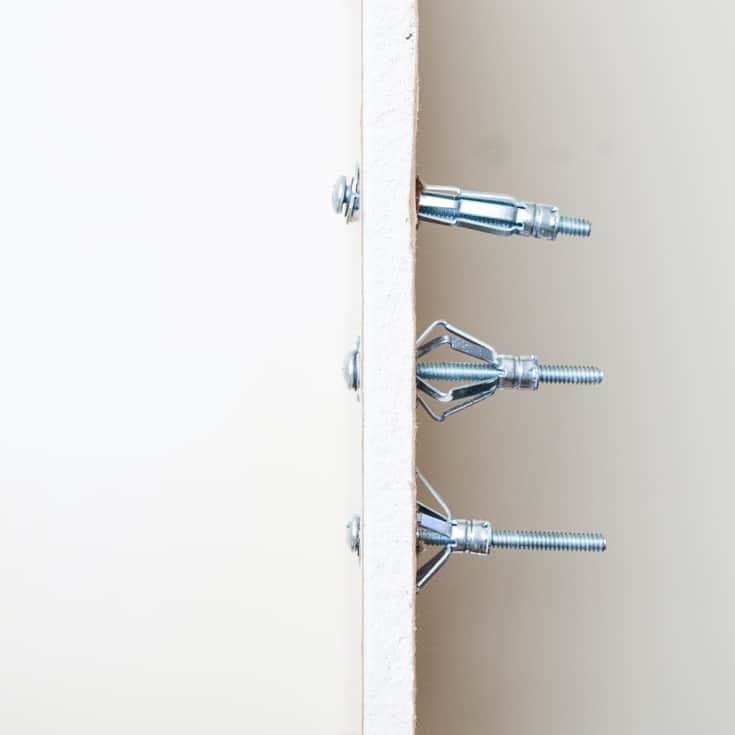
anchor?
Anchor? I hardly knew her!
ETA: happy cake day.
I hate these things. They deform far too easily. Toggle bolts and other metallic anchors are so much nicer to deal with.
Removed by mod
Molly’s are my favorite for drywall. They distribute the load well, and don’t move once in place.
I don’t like those “new” plastic screw-in anchors for drywall. They do work well, but they make as big a hole as molly, without the stability.
And these are the wrong ones for any kind of drywall, which is like 97.2% of homes in the US. Even brick often has drywall or plaster on the interior now.
They work well in hard materials, like brick, concrete, etc.
Removed by mod
😭 I have two of those actively pulling out of my lathe and plaster walls. I don’t know how to fix it other than just take down the shelves, fully patch it, and never use that part of the wall again.
I should have gone with the plastic ones that reach out behind the thin plaster to grip on, because failure wouldn’t have destroyed the wall, but my dumb ass listened to the dude who told me the metal screw-in setbolt option was the superior option.
😯 Oh no! I’m so used to dry-wall/gypsum board that I forget that lath and plaster exists.
I’m not super familiar (just DIY) but, I think that you can make a patch that’s structural enough to take a new anchor. Definitely would need to be sure that there’s enough lath for our to hold onto and likely would want some fiberglass mesh tape to reinforce it.
Looks to be a bit of a pain (cleaning hole corners, using patching plaster and bonding agent, waiting for cure, etc). However, if done right, I think it would be sturdier than a typical patch in drywall.
Do consult someone who knows about the stuff though, like a professional plaster person or builder.
Haha wasn’t anything personal, or meant to make you feel any sort of way, just an old-school problem with modern tech exacerbation.
My house is 140 years old and modern advice doesn’t apply to most of it unfortunately. Every project ends up being a dozen more projects because nothing from then applies to now.
But I’ve learned. So if I choose to lathe and plaster my next house, well I can fix it, too, damnit.
These things are called “Dübel,” which is also a casual term for joint in German, and can also be used as a verb: “einen dübeln” means to smoke a joint — all things that help humanity progress.
Funny enough, before “einen dübeln” became smoking weed it was also used for fucking. Which left me very confused a few times.
The kind of basic plug shown in the article is really poor for anything other than concrete. In my 15 years of experience hanging things on walls, floors, and ceilings professionally, I always recommend the Fischer DuoPower as the best all-around general-purpose anchor. As long as you’re using the correct length, these won’t pull out without taking a big chunk of the wall with it.

Now, if you want the absolute strongest anchor out there - especially for mounting something like a TV stand to drywall - I’d go with a so-called molly anchor. Just keep in mind, these are permanent. Once it’s in, it stays in.