
You must log in or register to comment.
- 6 months
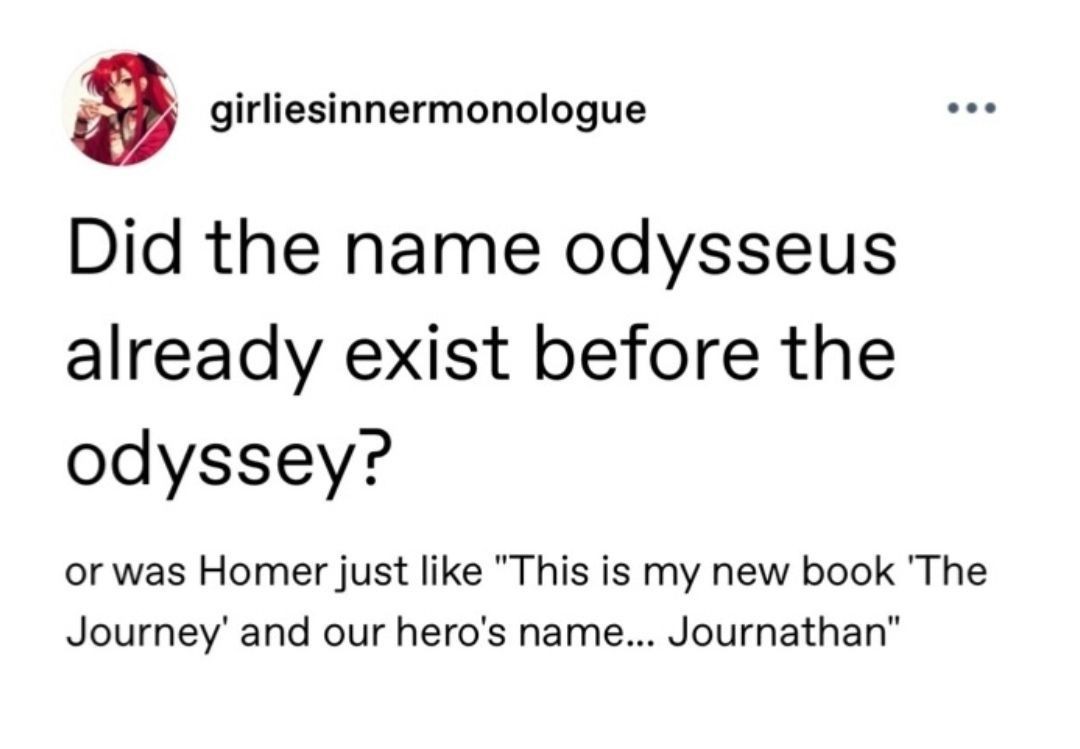
Its exactly the other way round. Odysseus was a common name, Odyssey didn’t exist as a word.
So the travels of John are the Johnenning and everybody just accepts that as a new word afterwards.
 6 months
Look man, if John killed a giant one-eyed monster and sailed to where the dragons lived, I would happily call an epic journey a Johnenning.
- 6 months
The Aeneid came before the Odyssey, so it wasn’t even an original take or anything!
- 6 months
While it’s still probably not wholly original, the Odyssey is about 8 centuries older than the Aeneid.
- 6 months
Is it? Dammit that’s what I get for posting without checking. My Latin teacher would be… well, she wouldn’t surprised I fucked up. Probably even pleased I remembered her lessons from thirty five years ago.
Ah well, thanks for the correction.- 6 months
The hint was that the Aeneid is Roman and the Odyssey is Greek. Greece is centuries before the Romans.
- 6 months
Indeed, that was my thought as I replied above. Clearly that was like me saying Ovid had copied La Fontaine with his tales of animals…
IIRC Odyssey literally translates to “The Tale/Journey of Odysseus.”
- vateso5074@lemmy.worlddeleted by creator6 months
Similar to how Virgil’s Aeneid is just “the story of Aeneas” and Homer’s Iliad is “the story of Ilion” (Ilion being the Greek name of Troy).
- 6 months
This is actually false in a literal translation sense. That’s the interpretation/implication of the title. Similar to how you would interpret the title of a biography called, “Abraham Lincoln”, as “The story (of the life) of Abraham Lincoln”, despite the latter not being the actual title.
In this case, the title is literally “Odysseyus” where “-us” is the nomative (subject) case case marker required in Latin. The English literal translation is, therefore, simply “Odyssey”, his name.
Because it’s an epic story, however, it matches English and general writing conventions to translate it as “The story/journey/epic/tale/what-have-you of Odyssey.”
Over time, especially in English, “O/odyssey” has taken on a more generic term, as well. So, adding the extra stuff in an interpreted translation (vs. literal translation) also helps differentiate the title of the book from a generic odyssey that might be a grand adventure by/with a different main character.
- 6 months
“Wherefore shall thy goods be lain”, sayeth the merchant.
Quoth the Journeyman, “Any way you want it, that’s the way you need it.”
- traceur201@piefed.socialEnglish6 months
This is my new book ‘jojo’s bizarre journey’ and our hero’s name… journathan joestar

