

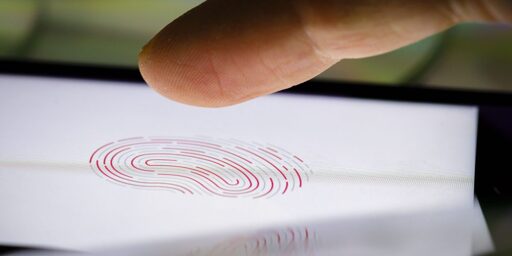
The recent federal raid on the home of Washington Post reporter Hannah Natanson isn’t merely an attack by the Trump administration on the free press. It’s also a warning to anyone with a smartphone.
Included in the search and seizure warrant for the raid on Natanson’s home is a section titled “Biometric Unlock,” which explicitly authorized law enforcement personnel to obtain Natanson’s phone and both hold the device in front of her face and to forcibly use her fingers to unlock it. In other words, a judge gave the FBI permission to attempt to bypass biometrics: the convenient shortcuts that let you unlock your phone by scanning your fingerprint or face.-
It is not clear if Natanson used biometric authentication on her devices, or if the law enforcement personnel attempted to use her face or fingers to unlock her devices. Natanson and the Washington Post did not respond to multiple requests for comment. The FBI declined to comment.
that’s not good enough anymore. decades ago the US put enough pressure on switzerland to end the use of anonymous banking and set up what’s called SWIFT and KYC. do you really think putting datacenters in other countries will be enough protection like banks in switzerland “was”?
Of course not! For this reason you need different providers and jurisdictions for datacenters, operating systems, encryption providers.
It’s the very same principle tor works: sure you can do traffic analysis and be able to “unmask” a tor user… and for this reason tor deliberately sends traffic across 3 different jurisdictions. Is it still possible to force 3 different nodes to cooperate for the unmasking? Sure… but you need 3 jurisdictions to collaborate with that.
Also, fun fact: bank secrecy is still in effect for Swiss residents (regardless of the citizenship) and people resident outside of the US and EU. Because things are always more nuanced than they seem 🙂
“secrecy”
all it takes is a subpoena from any jurisdiction, and that secrecy disappears, proving it never existed.