You must log in or register to comment.
- 1 year
Nah, it’s the last 20 % that are so hard. Roads with bad markings, custom traffic signs, construction sites with confusing routing, police giving directions, dirt roads, parking on private property and all the myriad of other non-standard situations that we can easily navigate without even thinking.
- 1 year
This, you just need light hitting wet pavement in the wrong angle and you won’t see any road markings.
- 1 year
“Easily”
Buddy, plenty of people can’t drive properly on well marked roads.
Watch this Video by NotJustBikes. It’s an hour long, but since I saw it, I’m not that interested in self-driving cars anymore.
https://m.youtube.com/watch?v=040ejWnFkj0&pp=ygUgbm90IGp1c3QgYmlrZXMgc2VsZiBkcml2aW5nIGNhcnM%3D
Car companies bought public transport networks to kill them and sell their cars. What would cities look like if all cars are self- driving? The answer which NotJustBikes assumes is more plausible than I’m comfortable to admit.
- 1 year
IIRC some self-driving systems even break road laws by not coming to a full stop at stop signs.
- 1 year
It’s really not, there’s plenty of videos showing they have trouble interpreting road markings, and also hallucinate cars, walls, and people around them.
They have lots of problems. The video of the one blowing a stop sign in San Fran wasn’t because other cars are around.
The Chinese Tesla that sped to it’s death randomly, wasn’t because other cars were involved.
- 1 year
Well technically traffic laws and markings are intended for humans not machines if human drivers were eliminated the roads could be reconfigured to better suit self-driving cars. Same thing if you try to make a robot exactly replicate humans it won’t be that good but if you make a non humanoid robotic system that’s configured for automation it will be more efficient.
- 1 year
Yes, autonomous vehicles will probably be better drivers than the a stage human when the technology is more mature. As far as I know, in an idealized futuristic city any cars would be autonomous. The issue is that they’re all cars, and so have some inherent problems with efficiency and safety that can’t be fixed by self driving.
The real solution to unsafe roads is trains. Worried about pedestrians? Put the trains underground or up high, where pedestrians aren’t. Crashes? You rarely have two trains in the same place at the same time. Drunk/reckless/otherwise stupid drivers? Trains have much more well trained and vetted drivers. And that’s not talking about all the efficiency side that trains are really good at.
- 1 year
Buses don’t stop at every housing unit.
Trams are just tiny trains.
Not everybody can walk.
Not everywhere has bicycle storage.
- 1 year
Your solution is to raze all housing that’s not immediately adjacent to a train stop?
- 1 year
Agreed. You go furniture shopping, you can’t really carry a couch back home in the tube. Cars won’t be entirely replaced, but they wouldn’t be needed in most of their current use cases
- 1 year
As far as I know, in an idealized futuristic city any cars would be autonomous.
Neo: “What are you trying to tell me? That any cars would be autonomous?”
Morpheus: “No, Neo. I’m trying to tell you that in an idealized futuristic city, you won’t need cars.”
Pedestrians and cyclists are also a thing. I do not trust any type of vehicle around them.
- 1 year
I do not trust cyclists around vehicles either. I hope everyone can agree for better cycling roads, separated from motorized vehicle roads.
- 1 year
I do not trust cyclists around vehicles either.
That’s cute, but the untrustworthiness really only flows in one direction, and it’s not the one you wrote. There’s a reason roads never needed traffic signals or a whole bunch of rules until the automobile showed up, and why multi-use paths closed to automobiles still don’t.
 1 year
Everyone makes mistakes. Cyclists and pedestrians are just as imperfect as drivers. I can not trust a cyclist or pedestrian to not maneuver in front of my car unsafely the same way I can not trust other drivers to always be safe. That is literally the entire point of “defensive driving.”
- 1 year
I can not trust a cyclist or pedestrian to not maneuver in front of my car unsafely
Yeah, but the point you’re missing is that the factor that causes the danger is your car. Pedestrian-pedestrian collisions, pedestrian-cyclist collisions, and cyclist-cyclist collisions are all relatively rare and relatively minor. For the most part, people using every other form of transportation can trust other users of the street to maneuver around them safely, as long as no cars are involved.
That is literally the entire point of “defensive driving.”
Yeah. And it’s also the reason it’s defensive driving, specifically. “Defensive walking” and “defensive cycling” are not things, except in the context of trying to coexist with cars.
The problem is cars. Only cars.
- 1 year
Well, yeah, but we’ve been able to build a self-driving vehicle like that since the 1950s/1960s.
- 1 year
Well, yeah, human drivers are the real problem. They’re really bad at it - easily distracted, use poor judgment, have terrible sensors, and currently cause over 40,000 deaths per year in the US alone.
Replacing any number of them with objectively safer drivers would make the roads inherently safer.
- 1 year
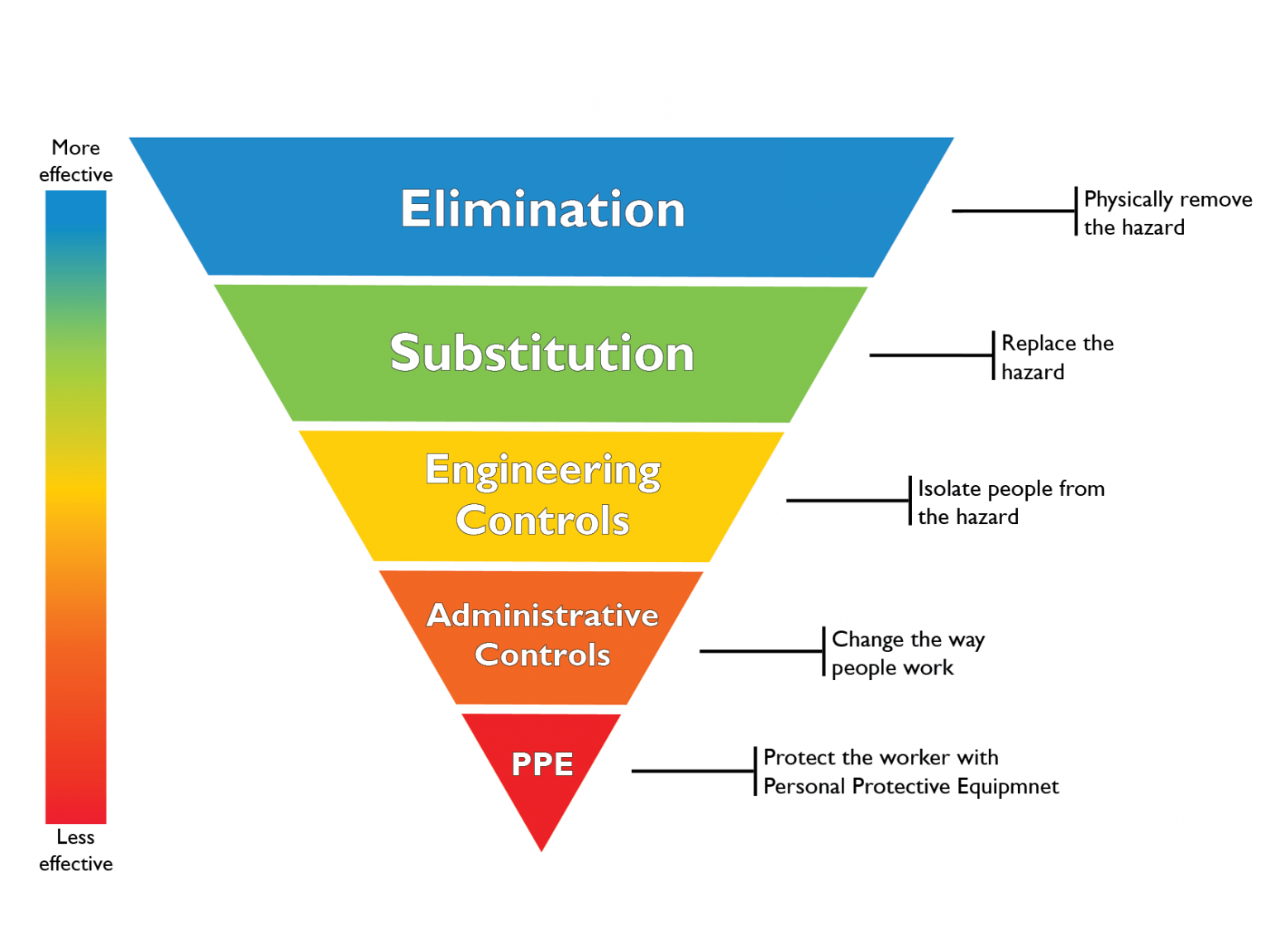
Pretty sure 1 ton of metal crashing into you at 35 mph is going to be deadly no matter what controls it. Educating drivers and reducing driving complexity is not going to change the fact that you are interacting with a deadly hazard on a daily basis
https://www.qlicksmart.com/wp-content/uploads/2021/07/Hierarchy-of-Controls-HD-1536x1152.png
- 1 year
There’s a limit to how much you can educate the average driver. People are dumb. And you can’t train away emotion, or tiredness.
As I previously stated, an objectively safer system that eliminates the problematic human element would in fact be safer.
A vehicle being controlled by something with five different sensors detecting an obstacle is going to have an easier time stopping than one controlled by some dipshit texting another dipshit.
- 1 year
In other words, “self-driving autonomous vehicles are probably okay when a condition that will never exist, exists.”
- sir_pronoun@lemmy.worldEnglish1 year
Yeah not trying to be a douche, but leave that thought in the shower ;)
You’d probably also need infrastructure built for autonomous cars, which might not happen.
- unemployedclaquer@sopuli.xyzEnglish1 year
They could build these like metal lines that go everywhere to guide the vehicles and call them rails
Probably too much infrastructure though
- 1 year
Yeah, having rails stopping at every single building would probably be a bit of a project
Maybe we could just put some smooth multipurpose surface down instead
- 1 year
Blind people cannot drive. They exist. Or how about people too young to get a driving permit? Or people who cannot afford to buy, maintain, insure and store a vehicle?
Reducing car dependency increases mobility.
- 1 year
“Tell me you’ve never actually asked a disabled person what they wanted without telling me you’ve never actually asked a disabled person what they wanted.”
- 1 year
That’s called a “freeway,” and we already have all the ones that were financially feasible to build (and additionally are saddled with a bunch more that weren’t).
Yeah, this has been known for a while. The problem is, there’s no realistic way to just switch everything all at once to such a system. So we still gotta make it work with human drivers who suck at driving so it can slowly be phased in.
- 1 year
FYI, that will never, ever happen. Not ever, no matter how advanced technology gets. Why? Because the nature of a “street” is to be a platform for creating a place and thus will never have humans and non-computerized vehicles excluded from it.
- 1 year
Great shower thought, but as someone who has comfortably rid in Waymos and Teslas the reality is different.
It’s always weird to see the automatic car debate happen on the internet, and then hop in my friend’s car and it drives us from work to his house 40 minutes away without needing any human intervention